Showing posts with label Historical Monuments. Show all posts

Wednesday, March 28, 2012

The Statue of Dr. Jose Rizal in Islas Filipinas, Madrid, Spain

I am currently in Madrid and had the chance to explore Spain's capital city. I did not knew it until a friend told me that Dr. Jose Rizal, the national hero of the Philippines has a statue in Madrid, Spain. I was challenged after knowing that Dr. Rizal really has a monument in this city. Being a traveller and exploreR, I did not hesitated to go to Islas Filipinas alone. I rode the Metro from Sol going to Islas Filipinas. With the help of the map, I finally found the statue of Dr. Jose Rizal last Tuesday, March 27, 2012.

The statue of Dr. Jose Rizal in Islas Filipinas in Madrid, Spain. I was there!

Tuesday, March 13, 2012

Touring Troy, Turkey

I guess you are very familiar about the dangerous computer virus called Trojan Horse or Trojan Virus. A Trojan Horse derives its name from the Trojan War. Legend has it that King Odysseus built a Trojan Horse as a gift to the city of Troy to signify surrender. He then ordered the Greek army to retreat and left the ‘gift’ outside the city gates. However it turned out that the Horse had more than 40 soldiers hidden in its belly. Once inside the city of Troy, these soldiers snuck out and opened the gates for their fellow soldiers who went on to attack the unsuspecting city with iron weapons.

It is an honor for me to visit this historical place named Troy in Turkey. I thought I can only see it on postcards or images in the internet but I was really there. Our tour guide explained to us about Troy, also called as Ilion and Troia in Greek, Wilusa in Hittite or Truva in Turkish.

Troia was added to the UNESCO World Heritage list in 1998.

Troy was a city, both factual and legendary, located in northwest Anatolia in what is now Turkey, southeast of the Dardanelles and beside Mount Ida. It is best known for being the setting of the Trojan War described in the Greek Epic Cycle and especially in the Iliad, one of the two epic poems attributed to Homer. Metrical evidence from the Iliad and the Odyssey seems to show that the name Ἴλιον (Ilion) formerly began with a digamma: Ϝίλιον (Wilion). This was later supported by the Hittite form Wilusa.

A new city called Ilium was founded on the site in the reign of the Roman Emperor Augustus. It flourished until the establishment of Constantinople and declined gradually during the Byzantine era.

The Trojan Horse during our vacation in Turkey last September 2011.

In 1865, English archaeologist Frank Calvert excavated trial trenches in a field he had bought from a local farmer at Hisarlık, and in 1868, Heinrich Schliemann, wealthy German businessman and archaeologist, also began excavating in the area after a chance meeting with Calvert in Çanakkale. These excavations revealed several cities built in succession. Schliemann was at first skeptical about the identification of Hissarlik with Troy, but was persuaded by Calvert and took over Calvert's excavations on the eastern half of the Hissarlik site, which was on Calvert's property. Troy VII has been identified with the Hittite Wilusa, the probable origin of the Greek Ἴλιον, and is generally (but not conclusively) identified with Homeric Troy. continue reading here.

Saturday, January 7, 2012

The South Gate of the Agora in Ephesus, Turkey

If you are planning to visit Turkey, you might want to include the ancient Greek city of Ephesus in your itinerary. This is one of the very interesting and historical sights in Turkey. The ruins of Ephesus are a favorite international and local tourist attraction. I had never seen such ruins as big as Ephesus.

One of the impressing historical sights there is the south gate of the Agora which is also known as the gate of Mazeus and Mythridates. They were the ones who erected this gate for their emperor, Augustus, who gave them their freedom. It is located near the Library of Celsus.

Today's archaeological site lies 3 kilometers southwest of the town of Selçuk, in the Selçuk district of İzmir Province, Turkey.

taken during our 10-days vacation in Turkey last September 2011.

At the right side of this gate, you can find the information that says below,

"The richly ornamented gate was financed by the imperial freedmen Mazaeus and Mithridates in 2 B.C. The refined articulation of the southern facade with alternating projecting and re-entrant elements, as well as the use of arches and beams, was repeated in the original side wings of the building. Statues of the imperial family stood on the inscribed attic zone. The unadorned northern side was connected to the Agora Hall. The re-erection of the gate (1982-1988) was made possible by Anton Kallinger-Prskawetz."

Thursday, December 8, 2011

Trajan's Forum in Rome, Italy

A friend of mine was asking me last time to mention to her if I can find a cheap trip to Rome, Italy. I found one but at the time I called the travel agency, it was already fully booked. Around two weeks ago she told me that she finally booked a trip to Rome. I am very glad for her because she can finally visit the so-called "Eternal City".

I had been to Rome last August 2010. It was only a 4-days visit including the flights and the sightseeing and I still find it too short to see everything. At least, I finally visited and experience the capital city of Italy.

One of the sights we visited was the Trajan's Forum, called in Italian as Foro di Traiano. It is an ancient structure in Rome, Italy and known as the last of the Imperial fora. It was constructed by the architect Apollodorus of Damascus.

Trajan's Column on the far left of the photo..I took it during our visit last Aug. 2010.

This forum was constructed on the order of Emperor Trajan with the spoils of war from the conquest of Dacia, which ended in 106. The Fasti Ostienses states that the Forum was inaugurated in 112, while Trajan's Column was erected and then inaugurated in 113.

To build this monumental complex, extensive excavations were required: workers eliminated the sides of the Quirinal and Capitoline (Campidoglio) Hills, which closed the valley occupied by the Imperial forums toward the Campus Martius.

the plan of Trajan's Forum.

Monday, October 24, 2011

Sights Not to Miss When Visiting Rome, Italy

There are a lot to see in this capital city of Italy. Rome known as "Eternal City", is the largest city in Italy. It is the famed city of the Roman Empire. It has been the centre of one of the globe's greatest civilizations ever. It has been the millenium-long centre of power, culture and religion that influence the world with its around 2,500 years of existence.

Rome has been one of the most visited cities in Europe. It has two international airports, the Leonardo da Vinci/Fiumicino International Airport and the Ciampino International Airport. The first one is the modern and large main airport of Rome and is well connected to the center of the city by public transportation. The latter is the city's low-cost airline airport usually serving discount airlines in Europe. This is one advantage if you are from Europe because you can always find cheap flights from any European cities to Rome.

There are a lot of sights to see in Rome. Here are a few ones which should be included in your list.

Vatican City

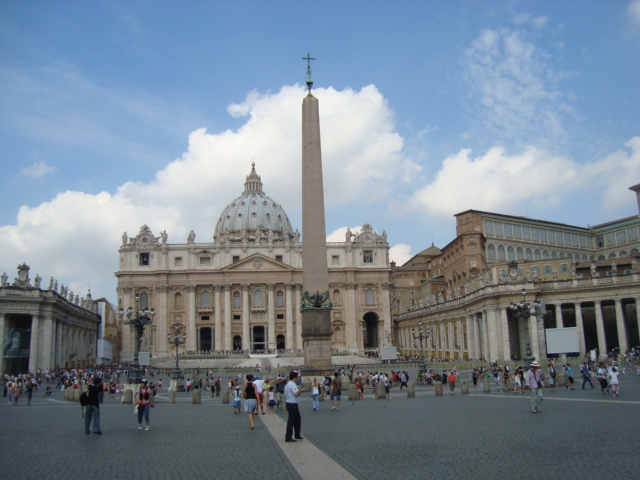
I guess I don't need to elaborate too much about Vatican City. My sister once asked me , if she has the chance to visit Rome, she wants to see and hear the mass presided by the Pope in St. Peter's Basilica. Sad to say, I was not able to hear the mass there and did not have the chance to see the Pope. Maybe in my next visit.

This is the so-called city within the city and known as the world's smallest state. The State of the City of Vatican is located within the city of Rome. The St. Peter's Basilica, the Vatican Gardens, St. Peter's Piazza, Vatican Museum, are among the main sites you need to see and experience in this city. We don't have a lot of time going to Castel Sant'Angelo which is very near this area.

Don't miss to climb up to the cupola of St. Peter's.. From there , you can have a good view of the city.
the obelisk in front of St. Peter's Basilica in Vatican City. One of my travel wishlist was fulfilled after our visit there last August 2010.

The Colosseum

This is also one of the must-see in ancient Rome which is considered to be the most famous of the Roman landmarks . It is also known as the Flavian Amphitheatre which can hold up to 50,000 spectators during those times. Gladiatorial combats and animal fights were ones held in this amphitheatre.

There is entrance when going inside the Colosseo.

I am happy to be there once in my life. I would love to visit this sight again in the future.

The Colosseum when completed measured 48 m high, 188 m in length, and 156 m in width. The wooden arena floor was 86 m by 54 m, and covered by sand.

The Roman Forum

This is one of the reasons why I still want to go back to Rome. Me and my friend Nonna were not able to go inside the Roman Forum, its name in Italian because of limited time. We only had a glance of it from outside.

The Foro Romano, as it is called in Italian, with its hallowed ruins were the most powerful seat of government in the world. It is normally a very interesting historical site. It is also not so crowded than the Colosseum. It is the best way of imagining the splendour and glory of ancient Rome.

The Trevi Fountain

This is considered to be one of the most fountains in the world. The Trevi fountain is the largest Baroque fountain in Rome. It is located near the Spanish Steps, also a famous sight in this city.

During my visit last year, me and my friend threw coins in the fountain. I only threw a euro coin believing that I will be able to visit Rome again in the future. At that time I still did not know about the legend of the "three coins". A current interpretation is that two coins will lead to a new romance and three will ensure either a marriage or divorce. Another reported version of this legend is that it is lucky to throw three coins with one's right hand over one's left shoulder into the Trevi Fountain.

The famous and beautiful Trevi fountain during our visit last August 2010.

The Pantheon

This was once a temple of the gods. Now it is a Catholic Church in Rome. Almost two thousand years after it was built, the Pantheon's dome is still the world's largest unreinforced concrete dome.

The Pantheon was under repair during our visit last summer 2010.

The building is circular with a portico of three ranks of huge granite Corinthian columns (eight in the first rank and two groups of four behind) under a pediment. A rectangular vestibule links the porch to the rotunda, which is under a coffered, concrete dome, with a central opening (oculus) to the sky.

There are still a myriad of sights to see in Rome. The ones I shared here are just a few among the most interesting ones.

Wednesday, October 19, 2011

Wonderful Trip to Ephesus, Turkey

Hubby was asking tonight if Ephesus was once a Greek city. He said that he read somewhere that it is. He finally found the travel flyer that says, Ephesus was once an ancient Greek city.

It was truly a wonderful and interesting trip we had in Ephesus. It is on the west coast of Asia Minor, near present-day Selçuk, Izmir Province in Turkey. No wonder an online friend told me that there are more ruins in Ephesus as in Greek today. The ruins in Ephesus are truly amazing. The architecture during those times are truly a work of engineering considering that they still don't have the modern machinery and equipments like what we are using now.

the library of Celsus in Ephesus..We visited this historical site last September 23, 2011.

There were a lot of international and local tourists at the time we visited Ephesus last September 2011. Partly owing to its easy access from Adnan Menderes Airport and via the port of Kuşadasi, this archaeological site is now a favorite destination of both local and international tourists.

striking a pose in Ephesus. In my background is the Theater of Ephesus. It was like taking a journey back in the past..a must-visit place when visiting Turkey.

Ephesus was one of the seven churches of Asia that are cited in the Book of Revelation. The Gospel of John may have been written here. The city was the site of several 5th century Christian Councils, see Council of Ephesus. It is also the site of a large gladiators' graveyard.

Friday, October 7, 2011

The Heroes' Square in Budapest, Hungary

I remembered one of the tourists who was with us during our trip to Budapest last August. She said that she was fascinated about this part of Budapest which is the Heroes' Square. Hősök tere, as it is called in Hungarian is one of the major squares of Budapest, Hungary, rich with historic and political connotations. It lies at the end of Andrássy Avenue (with which it comprises part of an extensive World Heritage site), next to City Park.

the Millennium Monument, in front of it is a large stone cenotaph surrounded by an ornamental iron chain.

taken during our visit last August.

Hősök tere is surrounded by two important buildings, Museum of Fine Arts on the left and Palace of Art (or more accurately Hall of Art) on the right. On the other side it faces Andrassy Avenue which has two buildings looking at the square — one is residential and the other one is the embassy of Serbia (former Yugoslavian embassy where Imre Nagy secured sanctuary in 1956).

Saturday, June 11, 2011

Rainy Summer Days in Paris, France

It was summer season last year, when we visited Paris, the capital and largest city in France. My shoes were wet as we walked down to some of the main sights in this global city. Paris known as the "The City of Lights" is truly one of the must to see when visiting Europe.

I was glad again to visit one of the world's leading business and cultural centres. Paris is always an interesting city for me.

The Eiffel Tower, the famous and most iconic symbol of Paris. You see how gray the sky was during our visit last August 2010. My first visit in this city was last March 2009.

Friday, May 27, 2011

The Colosseum in Rome

Let's go back in time and history by visiting the iconic symbol of Imperial Rome. Colosseum or Coliseum is considered to be one of the greatest works of Roman architecture and Roman engineering. I can't imagine how the workers and builders built this magnificent architecture during those times when there were still no modern tools and machines like what we have now. The Colosseum was used for gladiatorial contests and public spectacles during the Roman times. It is considered to be one of the most popular tourists attractions in Rome.

It was truly a wonderful and stunning trip we had in Rome last year especially seeing its historical ruins and architecture.

The Colosseum was built in ca. 70–80 AD. taken during our visit last August 2010.

Thursday, May 12, 2011

The Chamberlain Square in Birmingham, England

I am trying to remember my travels again. I was browsing my travel images awhile ago and found some pictures which were taken in Birmingham. It is located in West Midlands and by local authority district became Britain's second largest city.

The image you see below was taken in Chamberlain Square, a public square in Birmingham. It was named after Joseph Chamberlain, a famous and influential British who is a statesman, politician and businessman. This square is adjacent to Victoria Square.

The buildings located in this square include the Town Hall, the Central Library of Birmingham, the Council House, Big Brum, Birmingham Museum of Art and Gallery and Paradise Forum.

The Chamberlain Memorial and the Town Hall in the background. I believed the other monument is either of James Watt or Joseph Priestly. This was taken during my visit last Oct.-Nov. 2008 in Birmingham, England.

Sunday, March 13, 2011

The Louvre Museum in Paris, France

The Pyramide du Louvre, as it is called in French language, commonly known as the Louvre pyramid is a large glass and metal pyramid in the main courtyard of the Louvre Palace. It is also surrounded by three smaller pyramids. This structure has become one of the famous iconic symbol of the city of Paris.

The Louvre pyramid was said to be featured in the 2006 film, The Da Vinci Code.
These are images I took during my first visit in Paris last 2009. I was there again last summer 2010.

The Louvre pyramid and the Louvre buildings on the background. It serves as the main entrance to the Louvre Museum. It was commissioned by the President of France François Mitterrand in 1984 and was designed by the architect I. M. Pei.

The downward-pointing or the inverted pyramid, called in French as La Pyramide Inversée. It functions as a skylight in an underground mall in front of the museum.

Thursday, February 10, 2011

St. Stephen's Cathedral in Vienna, Austria

It is more than three years now since I had a trip in Vienna, Austria with a friend. It was actually an adventure which is full of excitement. One of the sights we visited in Vienna is the St. Stephen Cathedral. It is one of the city's most recognizable symbols and is really worth to visit.

taken last June 2007 during our trip in Vienna, Austria.

The church was dedicated to St. Stephen, who was also the patron of the bishop's cathedral in Passau, and so was oriented toward the sunrise on his feast day of 26 December, as the position stood in the year that construction began. Built of limestone, the cathedral is 107 meters (350 ft) long, 40 meters (131 ft) wide, and 136 meters (445 ft) tall at its highest point. Over the centuries, soot and other forms of air pollution accumulating on the church have given it a black color, but recent restoration projects have again returned the building to its original white. wikipedia.

Wednesday, January 26, 2011

The Parthenon in Athens , Greece

The Parthenon is dedicated to the Greek goddess Athena, whom the people of Athens considered their protector. It is a temple on Acropolis which dominates the city skyline of Athens, Greece. The Parthenon is regarded as an enduring symbol of Ancient Greece and of Athenian democracy and one of the world's greatest cultural monuments. Its construction began in 447 BC and was completed in 438 BC, although decorations of the Parthenon continued until 432 BC. It is the most important surviving building of Classical Greece, generally considered to be the culmination of the development of the Doric order. Its decorative sculptures are considered some of the high points of Greek art.

Thanks to my friend Ritche for this image taken during her vacation in Athens, Greece.
online accounting degrees

ORIGIN OF PARTHENON

The origin of the Parthenon's name is from the Greek word "παρθενών" (parthenon) referred to the "maiden's apartments" in a house and in the Parthenon's case seems to have used only to a particular room of the temple; it is debated which room this is and how the room acquired its name. LSJ states that this room was the western cella of the Parthenon. Jamauri D. Green holds that the parthenon was the room in which the peplos presented to Athena at the Panathenaic Festival was woven by the arrephoroi, a group of four young girls chosen to serve Athena each year. Christopher Pelling asserts that Athena Parthenos may have constituted a discrete cult of Athena, intimately connected with, but not identical to, that of Athena Polias. According to this theory, the name of Parthenon means the "temple of the virgin goddess" and refers to the cult of Athena Parthenos that was associated with the temple. The epithet parthénos (Greek: παρθένος), whose origin is also unclear, meant "maiden, girl", but also "virgin, unmarried woman" and was especially used for Artemis, the goddess of wild animals, the hunt, and vegetation, and for Athena, the goddess of strategy and tactics, handicraft, and practical reason. It has also been suggested that the name of the temple alludes to the virgins (parthenoi), whose supreme sacrifice guaranteed the safety of the city.
more details here

Monday, January 17, 2011

My Euro Travel in Passau, Germany

Passau is a also known as the City of Three Rivers. It is located in Lower Bavaria, Germany. This city is very historical considering that in 5000 BC, the earliest evidence of human habitation was found in Passau region. Its historical old town also reflects the beauty of this city.

I had been to this city thrice and if given the chance to visit it again, I will surely do. Here are some images I took during our visit last November 2009. Never miss to have a boat trip when you visit Passau.

This is a part of the Domplatz (Cathedral Square) in Passau's Stephansdom

The New Residence (Neue Residenz in German) on the left side, served as a palace of the prince bishops since its completion in 1730. The building with towers in the middle is the St. Stephansdom (St. Stephen's Cathedral) with its Gothic architecture. The fountain in front is called the Wittelsbacher Fountain.

Sunday, January 2, 2011

The Famous Manneken- Pis in Brussels, Belgium

Happy New Year! I hope that you all had a wonderful first weekend of 2011. I had quite a nice one and I can't complain about it. It seems that I was also away for some days. This blog had a little holiday break and I guess, let's begin to travel again.

I had already seen some images of Manneken-Pis in the internet and honestly, I don't have an idea about it. During my visit to Brussels, Belgium last August 2010, I finally found the statue of this very famous little boy. There is a good story I read about this legendary Brussels figure.

A legend says that a rich bourgeois had lost his only son in the crowd during popular festivities. After five days, he found him in the corner of Etuve Street, doing what the little man is doing. You know what I mean folks?

Manneken-Pis whose known to be people's friend has received many military and civil honours and distinctions. The Elector of Bavaria, Germany named Maximilian Emmanuel, gave him his first costume. Ever since then, the lords and burgesses have offerred him the most beautiful clothes. His wardrobe is probably the most varied and complete that has ever existed. There is a museum of his clothes in Brussels.

taken during my visit with a friend, Nonna in Brussels last August 2010.

see what the little man is doing? that is Manneken -Pis..a very cute figure in Brussels.

Saturday, December 4, 2010

The Spanish Steps in Rome, Italy

Let's go travel Europe again. I am not really very sure if I already shared about one of the sights in Rome, Italy called The Spanish Steps. With the name alone,n you will probably imagine that you will see a lot of stairs here. Yes, it is!

It is called in Italian as Scalinata della Trinità dei Monti. These are set of steps located between the Piazza di Spagna at the base and Piazza Trinità dei Monti in Rome, Italy. It is known to be the widest and longest steps in Europe. The church of Trinità dei Monti is located at the end of these steps. The stairway is said to have 138 steps.

I am happy that I had seen and experience this sight of Rome. Here is an image taken during our visit last August 2010.

The stairway of 138 steps was built with French diplomat Étienne Gueffier’s. A lot of tourist can be seen sitting here especially during summer time.

Saturday, November 27, 2010

The Pantheon in Rome, Italy

I had seen some replicas of the Pantheon building like in Paris, France, in Bavaria, Germany and if I am not mistaken also in Vienna, Austria. This time I had finally seen the Pantheon in Rome, Italy. Pantheon in Greek word means temple. The Pantheon in Rome was commissioned by Marcus Agrippa as a temple to all the gods of Ancient Rome, and rebuilt by Emperor Hadrian in about 126 AD.

During our visit to Rome last August 2010, Pantheon was under repair. You can see the image I took during our visit that time.

The building is circular with a portico of three ranks of huge granite Corinthian columns (eight in the first rank and two groups of four behind) under a pediment opening into the rotunda, under a coffered, concrete dome, with a central opening (oculus) to the sky. Almost two thousand years after it was built, the Pantheon's dome is still the world's largest unreinforced concrete dome. The height to the oculus and the diameter of the interior circle are the same, 43.3 metres (142 ft). A rectangular structure links the portico with the rotunda. It is one of the best preserved of all Roman buildings. It has been in continuous use throughout its history, and since the 7th century, the Pantheon has been used as a Roman Catholic church dedicated to "St. Mary and the Martyrs" but informally known as "Santa Maria Rotonda."

HISTORY:

In the aftermath of the Battle of Actium (31 BC), Marcus Agrippa built and dedicated the original Pantheon during his third consulship (27 BC). Located in the Campus Martius, at the time of its construction, the area of the Pantheon was on the outskirts of Rome, and the area had a rural appearance. Under the Roman Republic the Campus Martius had served as a gathering place for elections and the army. However, under Augustus and the new Principate both were deemed to be unnecessary. The construction of the Pantheon was part of a program of construction that was undertaken by Augustus Caesar and his supporters. They built more than twenty structures on the Campus Martius, including the Baths of Agrippa and the Saepta Julia. It had long been thought that current building was built by Agrippa, with later alterations undertaken, and this was in part due to the inscription on the front of the temple. However, archaeological excavations have shown that the Pantheon of Agrippa had been completely destroyed, and Emperor Hadrian was probably responsible for rebuilding the Pantheon on the site of Agrippa's original temple. more infos here

Friday, November 19, 2010

The Arch of Constantine in Rome, Italy

The Arch of Constantine in Rome, Italy looks like the Arch of Triumph (Arc de Triomphe) in Paris, France, the Siegestor in Munich, Germany and there are still a lot of structure around the world that looks like this. It was built to commemorate Constantine I's victory over Maxentius at the Battle of Milvian Bridge on October 28, 312.

The arch is 21 m high, 25.9 m wide and 7.4 m deep. It has three archways, the central one being 11.5 m high and 6.5 m wide, the lateral archways 7.4 m by 3.4 m each. The top (called attic) is brickwork reveted with marble. A staircase formed in the thickness of the arch is entered from a door at some height from the ground, in the end towards the Palatine Hill.

taken during our trip in Rome, Italy last August 2010

Friday, November 12, 2010

The Trevi Fountain in Rome, Italy

Let's go travel in Europe again! How would you love to visit Rome and see one of the famous fountains in the world? The Trevi Fountain, called in Italian as Fontana de Trevi was created by Bernini in 1641 and was continued by architect Salvi in 1735 under Pope Clement XII.

There is a legend about this fountain that says, whoever drinks its water or throws a coin in it will surely return to Rome. That is also the reason why I threw a coin during our visit last August 11-14, 2010. The Trevi Fountain is also known for its excellent water. It is also the largest baroque fountain in Rome.

Here are some images I took during our visit last August 2010.

a detail of the Fountain.

The Trevi Fountain is said to measure 25.9 meters (85 feet) high and 19.8 meters (65 feet) wide.

Sunday, October 24, 2010

Statue in Nuremberg, Germany


I finally had the chance to give you some updates. Let's begin with an image of the statue in the Old City of Nuremberg. I was trying to search online what is the particular name of this statue but it seems that I can't find its exact name. If you have to look closer to this statue these words in German were written on it, "Zerstören das Leben der Tod Lacht Hohn". There is something like a shield in front of it but I can't clearly read it also. It's time for me to apply my acne scar cream. I am still using one until now. This dark statue seems to depict death. I understand most of these words but I can't exactly put it into correct sentence. Zerstören means to destroy, Leben means lives, Tod means death, Lacht means laugh and Hohn is something like derision or mockery. Probably it means this way, "destroy the death of live laughs scornfully ". I will give you more information about this statue once I visit Nuremberg next time.

Twitter Delicious Facebook Digg Stumbleupon Favorites More